
11.2.1How fast am I going in component form?
Applied Calculus in Component Form
A tiny marble is rolling around an
Roberta is wondering where the marble will be located
seconds after it starts rolling. She evaluates the vector at and concludes that the marble will be at the point .
However, her teammate Eleanor is not convinced. “You are assuming that the initial position of the marble whenis at . But we are not given that information.”
Who is correct? Be prepared to share your reasoning with the class.As it turns out, the marble is located at coordinate point
at . Write a parametric function that represents the position of the marble at any time . Then use it to determine the actual position of the marble when . In the context of this problem, compare and contrast a vector-valued function that represents position with a parametric function that represents position. What information does a parametric function give that a vector does not? Likewise, what information does a vector give us that a parametric equation does not?
Julio is having a great time at Speedland, especially because it is a school day and his Calculus teacher, Ms. Koolnerd, has brought the whole class to the park for a fieldtrip.
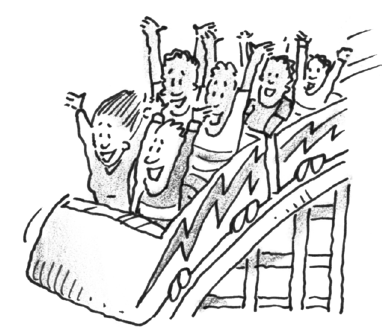
Julio is on the roller coaster shown at right. Just as the roller coaster starts descending, Ms. Koolnerd taps him on the shoulder from the cart behind him and hands him a card. On it was written as a parametric function that models the path of the coaster.
where

Julio quickly whips out his graphing calculator and sketches a graph of the parametric curve. You should do the same.
Determine the height of the coaster when
. Is that the highest it ever goes? How low does it go? Be prepared to share your strategy to answer these questions. Julio knows that the velocity of the coaster will change as it descends. “The lower we go, the faster we will fall!” But what about the horizontal component? Will the horizontal velocity change or stay constant? With your team, use
to answer Julio’s question. Julio wants to program his camera to take a picture of himself while the coaster is descending. He estimates that
will be a good time to take the shot. Write a parametric function that represents the roller coaster’s velocity at any time . Then use the equations to calculate the velocity at in vector form. Is the coaster descending at this time? How do you know? Julio is curious if he will be moving fast at
, but he finds it difficult to use the velocity vector to answer that question. “What I need,” thinks Julio, “is a scalar measurement.”
Julio decides to evaluateat to calculate the magnitude of the velocity vector at that time. Determine this measurement. Be sure to include appropriate units and explain its significance in the context of the problem.
Georgia drops her gum while gazing in awe at a bike rider racing down the street. At the moment that the gum hits the concrete, the bicycle wheel runs over the gum. The curve at right, called a cycloid, models the path her gum travels as the bicycle proceeds down the street.
The vector-valued function
.png)
Georgia is curious about the shape of the path of her lost gum on an
With your team, try Georgia’s method. Calculate the slope of the line tangent to the cycloid’s path,
, when seconds. Is the gum rising or falling at that moment? Explain how you know. Does the slope you found in part (a) represent the gum’s velocity at
? If not, what does represent in the context of this problem? Use component form to find an expression for the velocity of the gum at time
. Then write a note to Georgia about why the velocity vector must be expressed with two components. If possible, calculate the speed of the gum when
. If it is not possible, explain
why not.
Leslie wants to practice using derivatives to find the slopes of lines tangent to graphs of parametric equations, so her friend John makes up this example:
What is the slope of the line tangent to parametric curve given by
“Piece of cake!” says Leslie.
.png)
What are
and when ? “You sneak!” exclaims Leslie. “I can’t use
to find .” Why not? “You can’t stump me that easily,” says Leslie. “I’ll find a way to use rectilinear equations to do this.” With your team, help Leslie find another method to determine the slope at
, explicitly. Write the equation of the tangent line for
. In this situation, both
and were zero. What would have been the slope if only one of them was zero?

Position, Velocity, and Acceleration Vectors
Given a particle moving in an
Its position vector at any time,
Its velocity vector at any time,
Its acceleration vector at any time,
Its speed at any time,

A point travels along the curve
For any three points
What percent of the area inside the limaçon
Let
What are
and ?
Verify that
.
Multiple Choice: If
(a) and (b)
Multiple Choice: No calculator! Determine which of the values below is the result when four right endpoint rectangles are used to calculate the area under


